
The Northeast Rose Gardener
E-Newsletter
.jpg)
May 2011: The Rose Journal – Angelina & Mike’s Blog
We now have a blog, “The Rose Journal” which replaces this Garden Journal Page.
Visit our blog at www.therosejournal.wordpress.com to see “Musings and Adventures of Two New England Rose Gardeners.” We hope you visit The Rose Journal and leave comments.
April 2011: Two Rhode Island Gems – A Pretty Pair of Public Rose Gardens
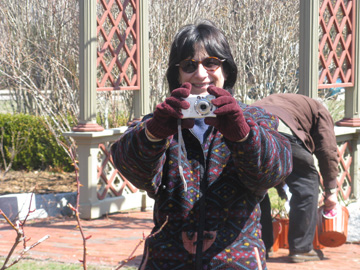 We helped to “open” two public rose gardens in April – the Victorian Rose Garden in Roger Williams Park in Providence, RI and the Chet Clayton Sustainable Rose Garden at the University of Rhode Island Botanical Garden in Kingston, RI. The Victorian Rose Garden is maintained by volunteers from the Rhode Island Rose Society (www.rirs.org). We have been involved in the RI Rose Society since its inception in 1998 when the 100 year-old Victorian Rose Garden wa
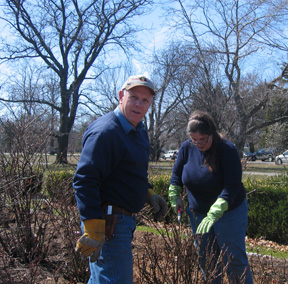 s totally restored and the Society became a partner with the Providence Parks Department in maintaining the garden. Upkeep includes Opening Day in April and Closing Day in November as well as several garden meeting during the summer. The public is always welcome to attend these sessions and experience hands-on instruction in pruning, planting, and caring for over 500 rose bushes. The varieties in this garden are sustainable by necessity since neither the parks Department nor the rose society will apply chemical pesticides. (Above left: “Photog Angie” at RWP Rose Garden Opening Day (taken by Sofi Cofield); above right Mike at RWP Rose Garden pruning)
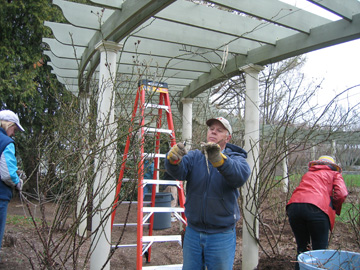 The Chet Clayton Sustainable Rose Garden is a younger and much more intimate garden and is sustainable by design. It was planted in 2005 and the maintenance is provided by a cadre of dedicated crew of URI Master Gardener rosarians. We were involved in the initial project of converting an old perennial bed into an elegant “Rose Circle” at the get-go. We selected the initial sustainable varieties with the understanding that no pesticides could be used to control insects and disease.We continue to act as consultants for the Clayton Garden and, like the Victorian Rose Garden, attend its April opening and fall closing and a few summertime activities there as well. (Mike at Clayton Rose Garden pruning climbers)
Visit these two very different horticultural gems in mid-June when they are in full bloom. For more information about either garden e-mail angie@rosesolutions.net
March 2011: Philadelphia Flower Show
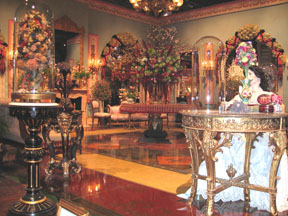 We went to the Philadelphia International Flower Show for the first time this year and were stunned by the size and quality of the displays and gardens. Not to mention that roses were everywhere! The theme was “Springtime in Paris” and every garden and exhibit depicted the Paris theme. From the re-creation of the Eiffel Tower to Monet’s Alleé, the Phantom of the Opera and La Vie en Rose, we were transported to the City of Light. We strolled through the spacious aisles marveling at the ingenuity and talent of all the exhibitors. There was an exhibit called “Le Salon des Fleurs” which was a drawing room reminiscent of a room in one of the Newport
 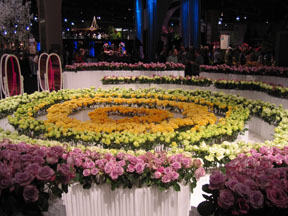 Mansions where everything was made from flowers. Even the swags around the windows were made of flowers: pale green hydrangeas and pink roses.
One of our favorite displays, “La Vie en Rose” based on French singer Edith Piaf’s story, included thousands and thousands of cut roses arranged in concentric circles, each stem in a tall white sleeve, each circle a different color. Amazing! At the entrance to the show, there was an oversized, elegant peacock made completely of flowers and moss. The “feathers” of this floral bird were pink roses, mauve carnations and emerald green moss. (Who thinks this stuff up?)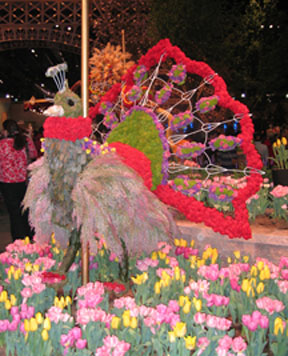
In addition to gardens and displays, there were floral arrangements galore plus French music, cabaret style singing and dancing on the Carousel stage that featured floral animals slowly rotating like a real carousal.
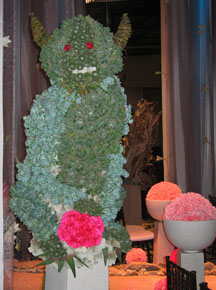 Another magnificent exhibit depicted Notre Dame Cathedral complete with four gargoyles made from countless sprigs of green and blue-green succulents inserted into an artfully sculpted oasis.
We spent an entire day at the Flower Show, taking several breaks to walk across the street to our hotel. Each time we went back we discovered something we hadn’t seen before.
On our final visit before going to dinner, the crowds had thinned and, as we took a stroll through the gardens and displays, we had the “streets” of Paris all to ourselves.
Everything about the Philadelphia Flower Show was first class, from the gorgeous gardens and displays to the interesting assortment of vendors. If you love plants and flowers then don’t miss a trip to the City of Brotherly Love on the first week of March to experience the next best thing to the Chelsea Flower Show in London!
February 2011: Winter Flower Shows Are “All the Rage”
It’s only February and we already feel the urge to get into the garden! But first there’s the winter flower shows. There is a plethora of them in New England starting in February with the Connecticut Flower Show and then the RI Flower & Garden Show where we will debut our newest program, “Sustainable Roses for New England Gardens.” On Friday March 18 we head up the road to the Boston Flower & Garden Show to present “Roses for New England,” a program that follows our book of the same name. This year we’re hitting the Philadelphia International Flower Show for the first time and are really looking forward to it. We’re including a few side trips while we’re there – to the Philadelphia Art Museum, for one, and maybe Longwood Gardens. Much will depend on the weather, but we’re hoping that the worst is behind us.
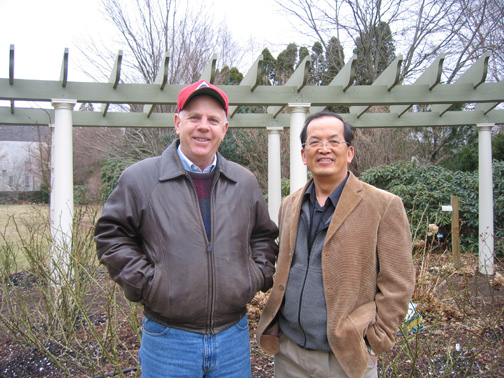 You’ve often heard us talk about the sustainability of some of the Easy Elegance roses at our programs. A few years ago Ping Lim, the hybridizer of the entire Easy Elegance series was invited to be the keynote speaker at the American Rose Society Yankee District Convention held in Connecticut. On the final day we offered to take him to the airport in Providence but we had some time to kill. So off on a mini-tour of Rhode Island we went. On the way to Newport we took him to the Chet Clayton Sustainable Rose Garden at the Botanical Gardens at the University of Rhode Island where many of his roses are planted. He got a big charge out of that! (See photo of Mike & Ping ). We’ve stayed in touch and a few weeks ago, we placed an order with him to bring in some of our favorite Easy Elegance roses: All the Rage, Super Hero, and Yellow Submarine (see below for descriptions and pictures). We grow all of them in our sustainable rose garden and recommend these attractive and disease resistant varieties in our book Roses for New England: A Guide to Sustainable Rose Gardening.
We will be offering a limited number of these three varieties for sale in mid-April – local pick-up only. They will be available either bare root or in containers. The cost for bare root (dormant roses with no soil around the roots) is $25.00 plus RI Sales Tax; roses potted up in containers cost $32.00 plus RI Sales Tax. Bare root roses have to be picked up within a week of notification before they break dormancy. For more information or to order, email mike@rosesolutions.net.
Sustainable Easy Elegance Roses: These are own-root roses and bloom repeatedly all season and into the fall.
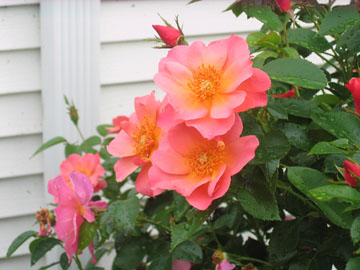
All the Rage (Shrub): For the past two years, our all around favorite rose has been ‘All the Rage’. It has delicate, apricot colored flowers with almost incandescent yellow centers that bloom in clusters of two to three. Its growth habit is orderly and upright, to about 4 feet tall and is extremely disease-resistant. (Hardy to Zone 4)
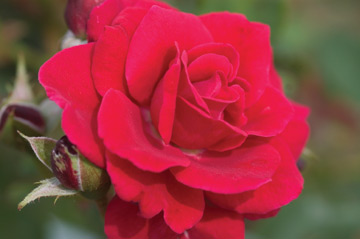
Super Hero (Floribunda): What a beautiful shape this rose has with 35 to 40 dark red petals that spiral out from the center. The dark green foliage is disease-free and is tied for first place with ‘All the Rage’ as our favorite rose. (Hardy to Zone 4)
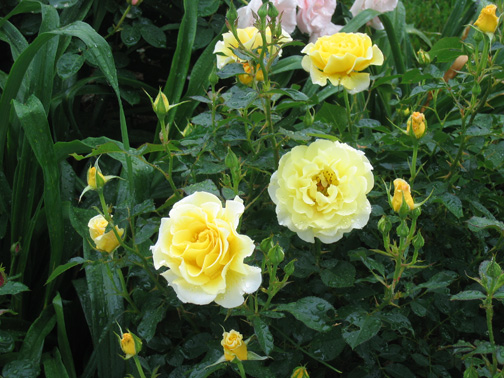
Yellow Submarine (Shrub): This rose has an upright habit and grows 4 feet tall in our garden. The blooms have about 30 petals that start out medium yellow, fade to a lighter yellow, then to an almost white as they mature on the bush. Flowers are 2 inches around with delicate petals that swirl around a center of gold stamens. (Hardy to Zone 5)
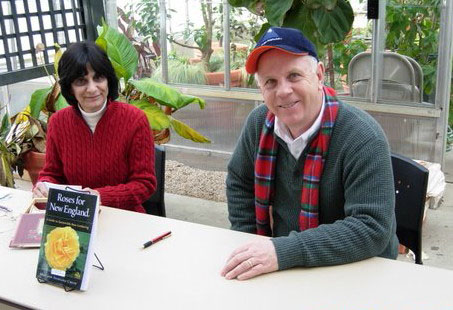 We introduced the book with our first book signing at the RI Rose Society’s February meeting which was appropriate since our fellow rose society members have been so supportive of our project. (See photo on left taken by Bob Desrochers.) Throughout 2010 we appeared at over 20 events with programs and book signings. What a pleasure to meet so many of you who have such an interest in rose gardening. We were delighted to realize that our book found its market by filling the need for gardeners who wanted specific information on rose horticulture in New England. Imagine our surprise when we received orders from as far away as France!
 Right now we’re busy planning events for 2011 and have some exciting venues on our schedule. We’ll be back at the RI Spring & Garden Flower Show in February; in March we travel up to the Boston Flower & Garden Show; and in April we will conduct a two-hour seminar at the Tower Hill Botanical Garden. For more information about our schedule, go to our News & Events Page.
We were so busy last year promoting the book and presenting programs throughout New England that we weren’t able to host an Open Garden weekend in June as we have in the past. This year, on June 11 and 12, we will be opening our garden to the public and on each day will offer a tour of our rose gardens so visitors can learn more about the types of roses we grow. If you would like to receive more information, email angie@rosesolutions.net to get on our mailing list.
In late fall, we restored two of our rose beds that had become invaded by tree roots and were stunting the growth of the roses planted there. We describe how we did this in an article titled “High Crimes and Dirty Deeds” on our Articles about Roses page. Look for it in a few weeks. If you would like to be on our mailing list to learn when new articles are uploaded, send us an email (angie@rosesolutions.net).
Currently, we’re revising our web site, standardizing each page, adding more photographs and information. We thank our web master Jean Chute who is doing a fantastic job via e-mail from Colchester, Vermont. Thank you Jean!
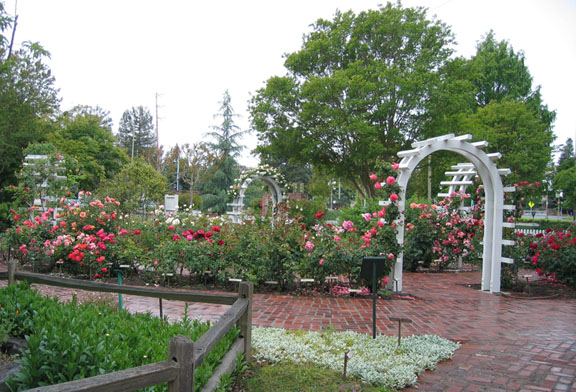 Every year around this time we plan our spring trip. Last year we traveled to San Francisco and toured the north coast and drove as far as the Redwood forests. When we travel, we always visit rose gardens along the way and one of our favorites was the Luther Burbank Rose Garden in Santa Rosa, California. (See picture on left.) This year we’re considering a Paris trip, so if you have any suggestions of sites too good to miss, let us know!
 Presently, we’re fine-tuning our Power Point program: “Sustainable Roses for New England Gardens” that will debut at the RI Flower Show. We’ll present an expanded 2-hour seminar version of this program on April 2 at Tower Hill Botanical Garden. Both of these programs are open to the public, so if you’re interested in sustainable rose gardening, come see us. We’d love to meet you!
Garden Journal Archives
2009
November 22, 2009
Chelsea Flower Show
David Austin Stand
|
David Austin Stand
|
|---|
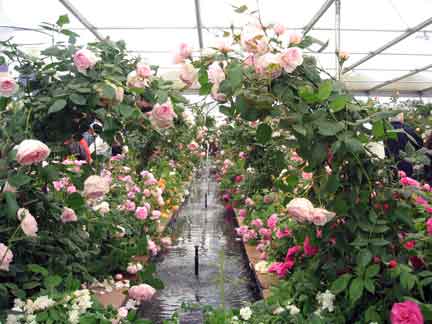
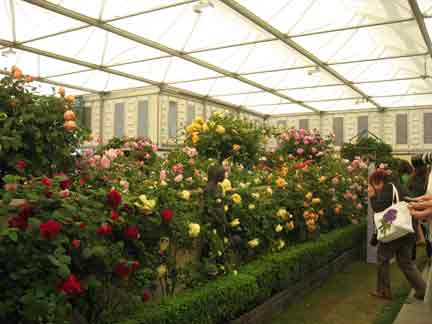
It’s been a while since our last Journal Entry; the spring and summer flew by and now it’s the end of November. In May we traveled to London to attend the Chelsea Flower Show for the first time and the trip was better than we had imagined. Once we acclimated ourselves to the time change, we jumped right into exploring the city. 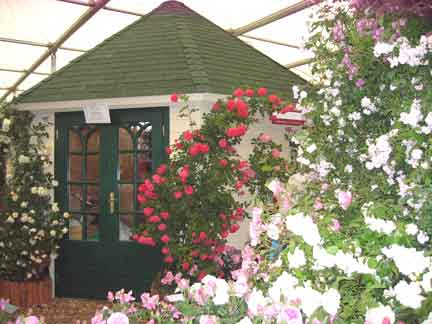 We purchased Oyster Passes that gave us unlimited transportation on those British red double-decker buses as well as the subway. It was no problem at all to hop on the bus right outside our hotel located across the street from the Kensington Palace and arrive at Sloane Square. Then it was an easy walk to the show grounds at the Ro
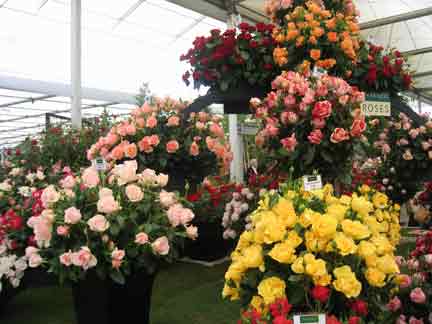 yal Hospital in Chelsea. What a day we had -- not only fabulous displays of roses and other flowers, but vegetables as well! Under the Great Pavilion we first found the rose stands (booths are called “stands” in the UK): David Austin, (see above), Peter Beales (left) and Harkness (right). We took picture after digital picture and include some of them below. (Click this link – Chelsea Flower Show - to read Mike’s article and see more photos.)
 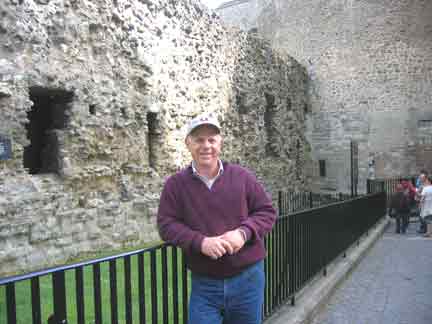 The next best part of the trip was all the sightseeing and “London things” we did; the Tower of London and the Crown Jewels (that’s Mike in front of the Tower and in the photo below is Angie with the London’s Tower Bridge as a backdrop); the awe-inspiring St Paul’s Cathedral; the British Museum and the Rosetta Stone; Harrods, where to my total amazement, we ran into Tony Curtis being interviewed by the British press at his art exhibit.
  We took the bus to the Portobello Market, held every Saturday for centuries on Portobello Street, where we joined literally thousands of people strolling along in search of everything from food to clothes to antiques and other collectibles. Our greatest find was a collection of colorful rose illustrations -- cigarette cards used to stiffen packs of cigarettes dating back to 1913. We took the tube to Kew Gardens and had a wonderful time despite discovering that the rose garden that we had been so anxious to see had been totally replanted the month before with new rose bushes. We didn’t go unrewarded, though. On our walk around Kew we found an area devoted to species roses and many of those were in bloom. If you have the chance to go to the Chelsea Flower Show, we highly recommend it. It was one of the highlights of our London trip and there truly is nothing to compare it to here in the states.
Open Garden
When we arrived home we had only a few weeks to prepare for our Open Garden. Luck was with us and provided fair weather that weekend. Our roses also cooperated and most were in bloom for our visitors. We had a lot of fun and were pleased to have so many of you come to visit and tour our gardens. (Photo at left is Mike giving an impromptu workshop on growing roses.) Some of the roses that were the stars of the tour included ‘Graham Thomas’ and ‘Super Hero’. Our climber, ‘Clair Matin’, one of the first roses to bloom in our garden, was in all its glory and its soft pink flowers stretched over 10’ high and spread just as wide on her trellis, creating a stunning wall of color.
Roses for New England: A Guide to Sustainable Rose Gardening
Once the Open Garden was over, we concentrated on finishing our book, Roses for New England. We had a deadline to meet, so for the rest of the summer, aside from tending our gardens, we were busy writing, rewriting and selecting photographs to include in the book. We are delighted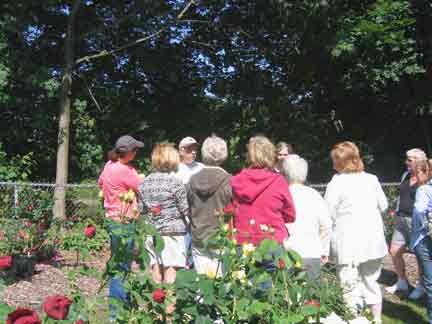 to report that the book is finished and will be available for sale on this website in February 2010. Look for more details including the cover and a few pages to appear here before Christmas. Finishing the book was like sending your child off to college – a feeling of sadness to see it going out the door to be published mingled with a bit of relief, too. Stay tuned for our next journal entry before the end of the year.
April 5, 2009
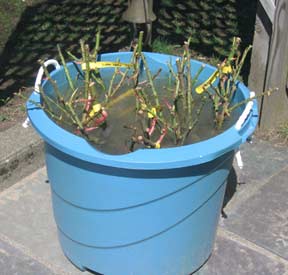
Bareroot roses are soaking in a big plastic tub on our patio -- the first sign that the 2009 rose season is under way. Every year we attend the Yankee District Convention (comprised of New England based rose societies) where the highlight of the Saturday evening festivities is a rose auction. Bailey Nurseries and Star Roses donated roses to the convention auction which included a nice mix of tried and true varieties as well as some new introductions. This year we bought Cinco de Mayo, a new 2009 AARS winner from Weeks Roses. The blooms on this floribunda have been described as “smoked lavender and rusty red orange” (how could we resist) along with the same glossy green foliage as Julia Child, one of its parents and a favorite of ours. We also picked up several Easy Elegance varieties that we especially like: Super Hero, a superb red with lots of petals on a bullet-proof plant; Macy’s Pride, a creamy white we planted last season; My Girl, a medium pink on a very sustainable bush; and a yellow we heard was very good called Centennial. The convention was a perfect time for us to introduce the first of our Botanical Art Collection, the Floribunda Series of men’s neckties that will be available for sale soon on our Garden Gifts and Gear Page. We’ve been having fun designing and working out the wrinkles, so to speak, of 100 % silk, hand-sewn neckties that we have designed with Susan Troy, a creative and talented textile designer from Rhode Island. She was able to create stunning, digitally printed silk fabric from digital rose photographs we took in our garden. The fabric is then cut and hand-sewn resulting in fabulous neckties -- unique wearable art. At the Saturday night dinner, Mike wore a dazzling, luminescent tie printed with perfectly formed, pink Sexy Rexy roses that grow in our back garden. Our next creation, a yellow floribunda rose tie – variety to be announced – is in the works.
Photo by Ed Cunningham
It’s almost time to remove the winter protection in our garden in the next few days and start spring pruning later in the month. Early April can be fickle with balmy weather one day and snow the next so we uncover slowly.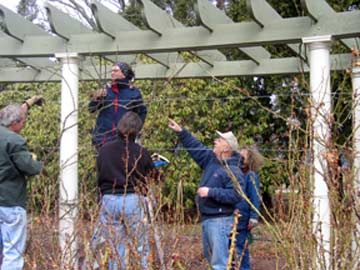 We’ve already had our first meeting at the Chet Clayton Sustainable Rose Garden at URI where dedicated Master Gardener volunteers met with us for a “Climbers” workshop. (See photo on left.) We’ll be back at the Clayton Rose Garden on April 11 for workshops on pruning and planting. The following Saturday, April 18, we’ll be at the Victorian Rose Garden at Roger Williams Park with the RI Rose Society to open that garden. Anyone interested in learning how to prune and plant roses is more than welcome to come to Roger Williams Park. (Go to www.rirs.org for more information.) This month we’ll be presenting our “Rosology 101” program at several gardens clubs as well as a 90-minute version for the 2009 URI Master Gardeners class. We’ll also premier our “Virtual Rose Garden” PowerPoint program on April 29 for the Barrington Community School. This program is open to the public (registration and fee is required; (go to www.barrcommschool.com for more information).
Plans are underway for our Open Garden weekend – June 13 and 14. If you would like information about this event, send us an email at contactus@rosesolutions.net.
February 8, 2009
We recently returned from a week’s vacation at Sugarloaf Mountain in western Maine where we enjoyed some great packed powder skiing even though the temperature barely rose above the single digits. We experienced a 20-inch snowstorm on our last day there. What would have panicked us southern New Englanders was taken in stride by the hardy folk in Maine and we sat back and enjoyed the snow. The day after we came home we traveled down to URI to meet with the Master Gardeners who volunteer at the Clayton Rose Garden. We were heartened to see so many rose enthusiasts who committed to the 2009 maintenance schedule planned that day. High on the agenda for this year is the training of the climbers, Opening Day and a mid-summer workshop on propagation.
Our 2009 season of programs and workshops has already begun with a speaking engagement at the Westport River Gardeners Club. Over thirty members attended and what an enthusiastic group they were! We enjoyed presenting our “Bullet Proof Roses” program and answering all their rose horticultural questions. February is a busy month for programs, and we’ll be visiting other garden clubs in the next few weeks. We attended New England Grows in Boston and came back with some ideas we will pursue. We’re also looking at designs for custom silk ties and rose jewelry to add to our Botanical Art line of merchandise.
Orders for Brownell roses continue to come in. There are only a few more plants of ‘Lafter’ remaining and a limited number of other varieties as well. (See our Brownell Catalogue) If you’re interested in any of these varieties, don’t wait too much longer or you’ll be disappointed. Once they’re gone, they’re gone until our next crop is ready for sale in 2010.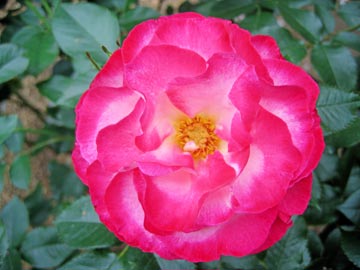 Meanwhile we’re preparing for the upcoming RI Spring Flower & Garden Show. The topic of this program is “T
 he Secret to Selecting Garden Roses.” Rose selection is the important first step in planting a rose garden. We point out that certain classes of roses, hybrid teas for instance, almost always require chemical pesticides to remain healthy and attractive. This becomes an important consideration when selecting new rose bushes. The best advice we give is to encourage gardeners to choose sustainable varieties that do not require pesticides and avoid the use of chemicals all together. We suggest different varieties, mainly modern floribunda's and shrubs, that are easy to grow and don’t rely on pesticides to be healthy.
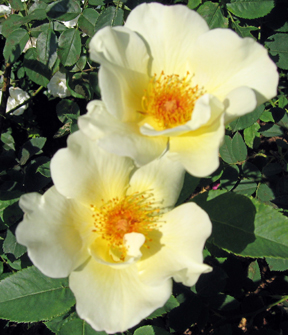
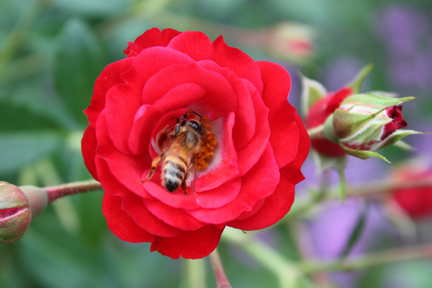 (Heart ‘n Soul above left; Sally Holmes, above right; Scarlet Meidiland, left) We describe how roses are graded and how to shop for them including plenty of tips that explain how to identify the best plants. For more information on the secret to selecting roses, come to the Flower Show and attend our program on Friday, February 20 at 11AM. We look forward to meeting you!
January 19, 2009
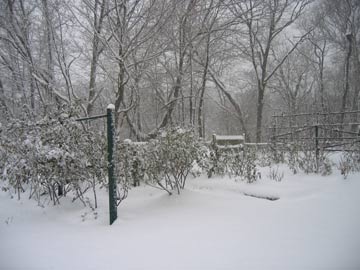 Thanks to our most recent snowstorm, our roses are safe and snug from winter’s fury under a thick blanket of snow. Snow is a natural insulator helping to protect garden roses from the wide fluctuations in temperature we experience in New England. It adds an extra layer of winter protection over the horse manure we hilled up around the base of each rose bush in November. In fact, a few days after Christmas when the temperature soared to 60 degrees for one day and immediately dropped back to seasonal levels, we were confident that our roses would remain dormant under their winter cover. Even though the gardens are covered in snow, we’re looking towards next season which starts for us with our winter/spring programs and workshops. We’ve developed a new Power Point program titled “The Secret to Selecting Garden Roses” which we’ll roll-out at the Rhode Island Spring Flower and Garden Show on Friday February 20, 2009. Another program in the works is “Sustainable Rose Gardening.” As long time advocates of sustainable rose gardening, we plan to demonstrate the step-by-step process in planting and maintaining a clean, pesticide-free rose garden. Sustainability is more than a popular catchphrase but a viable process for growing clean, healthy roses without compromising our environment. Simply put, our definition of sustainable rose gardening is:
First, a variety must be winter hardy and zone appropriate. If a rose can’t take New England cold even with some protection – regardless of any other positive attributes – we don’t plant it.
Second, each variety must demonstrate an above-average disease resistance and have the potential to remain healthy and attractive without resorting to chemical pesticides.
Last, and this is personal, sustainable roses in our gardens have to be generous repeat bloomers. When you work as hard as we do providing roses with everything they need to succeed then we expect flowers and lots of them.
With so many sustainable varieties already available and with more varieties introduced every year, this is definitely the time to start thinking about planting sustainable roses.
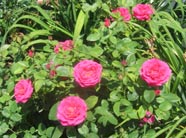 Our sustainable rose garden is now three years old and we assessed the performance of each bush late last fall and made some changes. The few roses that were struggling, mostly with fungal diseases, and deemed not sustainable enough to stay, were transplanted, passed along to others, or in a rare case, got the boot. (We are cold and clinical with evaluations…rose garden real estate is limited and, with a plethora of new varieties to try, there is no room for under-performing roses.)
 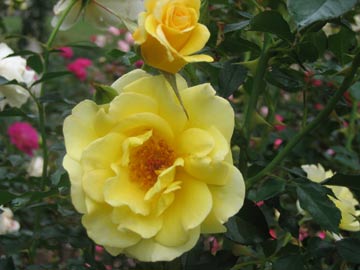 Some tried and true sustainable roses growing in our garden include: My Girl (above), All the Rage, Super Hero, Yellow Brick Road, Crimson Meidiland, Carefree Celebration, Pretty Lady (below) and Yellow Submarine (right).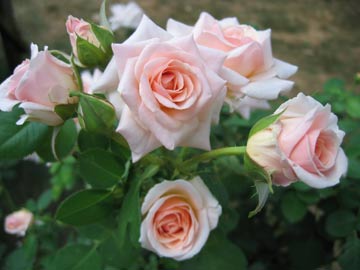
Work on our book, Roses in New England, continues with the focus on how to successfully grow roses in New England and, needless to say, an emphasis on sustainability.
2008
November 29, 2008
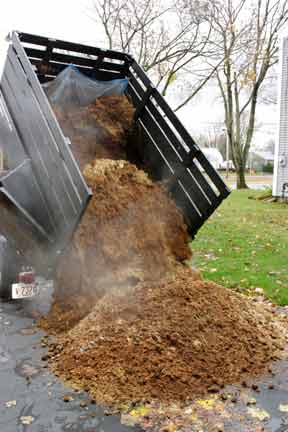 Its Thanksgiving weekend and we’ve finished putting our rose gardens to bed for the season. The bushes in the gardens are hilled up with horse manure and our potted roses have been gathered together and covered with leaves and wood chips. The whole process takes several weekends. First we had 2 yards of fresh horse manure delivered from a stable in nearby Massachusetts in early November. Next we spread a light coating of lime over each bed keeping the pH correct.
 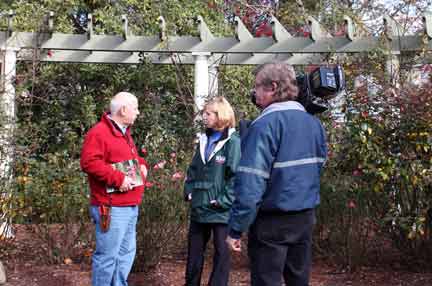 During this time Mike filmed a segment of “Plant Pro” for NBC10 about winter protection in the Chet Clayton Sustainable Rose Garden at the University of Rhode Island. (See photo of Mike and Dr. Marion Gold with a cameraman from NBC 10 above). But before we started winterizing our own gardens, we helped prepare roses for the upcoming winter months at the Clayton Rose Garden where we act as consultants. With a group of hardy Master Gardener volunteers led by Gene Wells and Marcia Herron, we braved a Saturday morning rainstorm in mid-November that miraculously stopped for the period of time it took for us to minimally prune and then hill up each rose. Our drive from East Providence to URI and back again took place in driving rain, but for the 2 hours we worked in the garden, the rose gods were with us.
 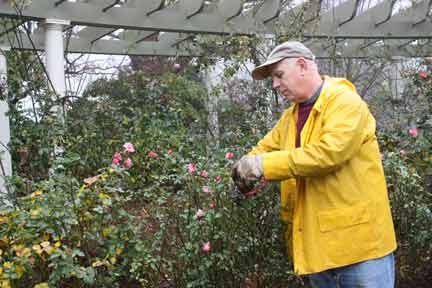 Once the roses in the Clayton Rose Garden were protected, we focused on our gardens. We removed some varieties to make room for others, transplanted roses from the back garden to the front and vice versa, and added a few new varieties to both gardens. In the front garden, we planted a load of yellow daffodils for early spring color plus English lavender to add the color blue to the palette. Then we divided large clumps of daylilies that are interspersed between theroses and finally hilled up each rose for the upcoming winter.
 Our back garden is strictly roses and by the time we were finished hilling up the 90 plus roses in the ground, our manure pile had shrunk quite a bit.
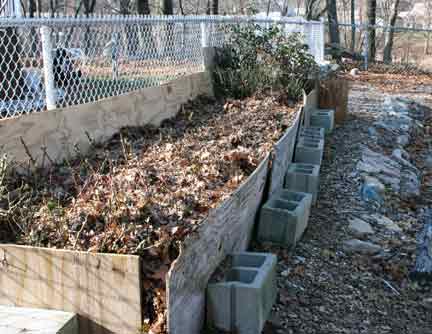
 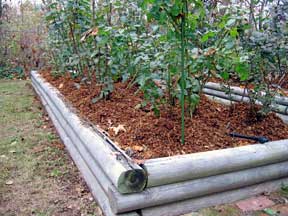 Next was the task of sheltering the 200 potted roses that remained as well as our crop of Brownell Roses. That was accomplished by building a crib along the chain link fence that borders two sides of our property. To protect the potted roses from winter winds, Mike enclosed an area with sheets of wood, placed the roses side by side, 4 or 5 pots, deep and covered them with shredded leaves. Whew! Now that the rose season is officially over we start planning for next season featuring our “Open Garden” which will be held June 13 and 14. You’re all invited! Stay tuned, more details to follow.
October 18, 2008
American Rose Society 2008 Annual
We’re very excited that the 2008 American Rose Society’s 2008 Annual has arrived in mailboxes across the country! It all started in May, 2006 when ARS President Steve Jones invited us to be the Guest Editors for the 2008 issue. Our challenge was to gather a wide variety of original articles on any topic relating to roses. We spent almost a year developing a theme –Roses are Forever-- and two dozen potential topics for articles that we felt were interesting and unusual and would appeal to a broad cross-section of rose gardeners. Eighteen rose writers across the United States, Canada and England accepted our invitation and began submitting substantial articles in February and March, 2008. Throughout last winter and spring we edited the articles as they arrived and sorted through hundreds of photographs. Over this past summer we worked closely with the ARS editorial staff in Shreveport, LA on page layouts and more editing. We completed our job in September when the Annual went to press. But now the job is over we can sit back and enjoy reading the Annual in its finished form. It’s been a wonderful experience. Not only did we get to meet rosarians from California to Rhode Island (and as far north as Alaska), but it was a great learning experience as well. The Annual includes articles about public rose gardens including the fabulous La Rosairie in the Montreal Botanical Garden, the Peggy Rockefeller Rose Garden in New York City, the Centenniel Rose Garden in Anchorage, Alaska and the Chet Clayton Sustainable Rose Garden in Kingston, RI. It has articles on the hybridizers Ping Lim and the Brownells, as well as articles about Austin roses, exhibiting shrub roses, garden roses, Mini-Flora roses, and organic gardening. We even have articles about rose illustrations and roses in needle arts. If you don’t want to miss out on these articles and more, we recommend you contact the American Rose Society. This ARS publication is available only as a member benefit to ARS members. www.ars.org
Here is an excerpt from “A Jewel of a Rose Garden – The Chet Clayton sustainable Rose Garden”
Deep within the campus of the University of Rhode Island, a few miles from the cooling effects of Narragansett Bay, nestled in the center of the URI Botanical Gardens, lays an elegant little jewel of a rose garden. Only three years old, the diminutive Chet Clayton Sustainable Rose Garden has become the darling of the university community as well as the URI Master Gardener orgnization which planted and maintains it. In three short seasons, this intimate garden room of roses has become a favorite seatting for weddings, university programs, meetings, and special occasions.
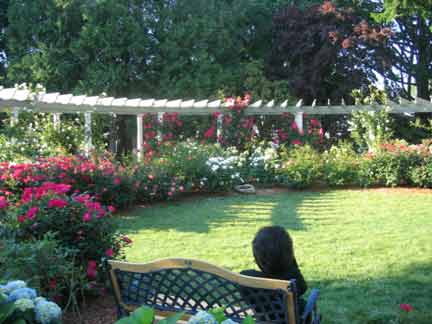
Clayton Rose Garden
If you would like to read the rest of this article, email Angie at Rose Solutions
Maine Botanical Gardens
Our summer wasn’t spent entirely working. We took time off to visit the Maine Botanical Gardens, located about 1-1/4 hours northwest of Portland, Maine and are glad we did. The scope of the Maine Botanical Gardens, which opened in 2007, was impressive. The Botanical Gardens, located in Boothbay Maine, contains lovely walking paths, some that meander along the Sheepscot River. The Rose and Perennial Garden which we were eager to see, is a short walk from the Visitor Center and features a gazebo with plantings of mostly shrub roses and perennials. It also includes a stunning granite floor with a large, two-tone stylized rose. The plant varieties were well-marked. Doing especially well were plantings of Knock Out and Aloha. We saw the shrub roses White Pavement, and Snow Pavement (many of the Pavement Series also grow in Anchorage’s Centennial Rose Garden), Bonica, Prairie Joy, Robusta, Autumn Sunset, White Meidiland, and Blanc Double de Coubert among specimens of Russian sage, yarrow, English lavender, and other perennials. From the Rose and Perennial Garden we continued along the easy walking trails admiring the Hillside Garden that gave us views of the river, stopping to relax in the Meditation Garden. Then we followed the Shoreland Trail that took us past the Fairy House Village. We explored the Rhododendron and Perennial Garden, walked down the Birch Allee lined with over 1,000 white birches and ended at the Kitchen Garden that featured various beds such as one called the Salsa Garden which grew everything needed to make a great salsa. The Maine Botanical Gardens is an ambitious project that continues to expand with future gardens under construction. With such a lovely spot and 248 acres of land, it’s a place to visit over and over again. For more information visit www.mainegardens.org
Blithewold Mansions
Closer to home is Blithewold Mansions located in Bristol, RI overlooking Narragansett Bay. We volunteered to present a program for Blithewold’s Fall Gardener’s Day and discovered what beautiful grounds and gardens surround the mansion. There’s even a Rose Garden! We were so enchanted with the location and the programs they offer that we signed up as members and look forward to seeing Christmas at Blithewold when all the rooms are decorated with trees and flowers. www.blithewold.org